
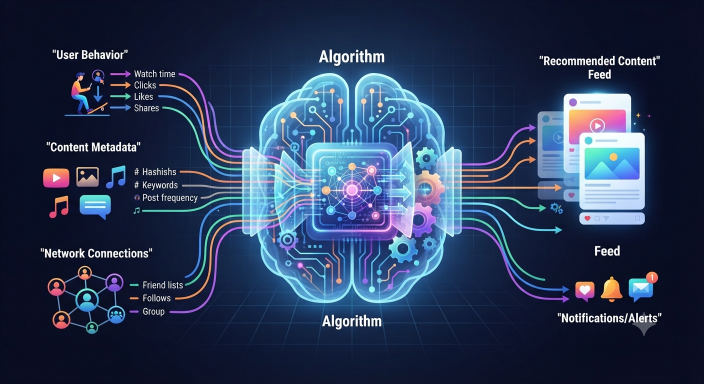
Have you ever noticed that after watching a few travel videos, your social media feed suddenly starts showing more holiday destinations, hotel recommendations, and travel tips? This is not a coincidence. Social media platforms use sophisticated algorithms to organise content and decide what users are most likely to find interesting.
Understanding how social media algorithms work can help users make sense of their online experiences and become more aware of how digital platforms influence what they see.
1. What Are Social Media Algorithms?
Social media algorithms are systems that help platforms organise and recommend content to users.
Without these systems, users would generally have to browse posts in chronological order or search manually for information.
However, platforms receive enormous amounts of content every second. Showing every post to every user would create an overwhelming experience.
Recommendation algorithms help filter this information and prioritise content that may be relevant to individual interests.
Platforms such as Instagram, Facebook, YouTube, TikTok, and X use different recommendation systems, and their exact ranking methods vary.
2. Your Likes and Comments Influence Your Feed
One of the most important signals used by social media platforms is user interaction.
When someone likes, comments on, saves, or shares a post, the platform may interpret that action as an indication of interest.
For example, if a user regularly interacts with cooking videos, the recommendation system may identify food-related content as relevant.
Similarly, frequently commenting on fitness posts may influence the appearance of workout routines, nutrition information, and exercise-related accounts.
These interactions help platforms understand what users may want to see in the future.
However, one interaction does not necessarily determine the entire feed. Recommendation systems usually consider several signals together.
3. Watch Time Matters More Than You Think
Watching a video for a longer period can provide useful information about user interest.
For example, if someone watches an entire travel video rather than scrolling past it immediately, the platform may interpret that behaviour as a positive engagement signal.
Some recommendation systems also consider whether viewers replay videos, finish them, or move away quickly.
This is one reason why creators often focus on making the beginning of their videos interesting.
However, watch time is only one factor. Different platforms use different ranking signals, and the importance of each factor can change depending on the type of content.
4. Your Search History Helps Personalise Recommendations
Search activity can also influence what appears on social media feeds.
When users search for particular topics, accounts, products, or locations, platforms may use this information to understand their interests.
For example, someone searching for international holiday destinations may start seeing travel-related recommendations.
Similarly, searching for skincare products or home decoration ideas may influence future suggestions.
This personalisation can make discovering relevant information easier.
However, users should understand that privacy settings and data collection practices differ between platforms.
5. Why You Keep Seeing Content From Similar Accounts
Social media platforms often recommend accounts based on user interests and previous interactions.
If someone regularly follows fashion creators, the platform may suggest other accounts producing similar content.
Recommendation systems can also consider connections between users, shared interests, and engagement patterns.
This helps people discover creators they might not have found through direct searches.
However, repeatedly seeing similar content may reduce exposure to different subjects and viewpoints.
Users can improve the variety of their feeds by exploring different categories and following a broader range of reliable sources.
6. The Role of Trending Topics and Popular Content
Trending topics often receive significant attention across social media platforms.
A viral challenge, major sporting event, entertainment announcement, or breaking news story may appear in recommendation feeds because of its popularity and relevance.
Platforms may consider factors such as engagement, freshness, topic relevance, and the interests of individual users.
However, popular content does not automatically mean accurate or trustworthy content.
Users should verify important information, particularly when dealing with health, financial, political, or breaking-news topics.
7. How Algorithms Influence What Creators Post
Social media algorithms do not only affect viewers. They also influence content creators and businesses.
Creators often study engagement patterns to understand which posts attract more attention.
They may experiment with video length, captions, posting times, thumbnails, and content formats.
Businesses also use analytics to identify which products, advertisements, and promotional messages generate interest.
As a result, creators may adapt their content strategies according to platform performance.
However, focusing only on algorithmic engagement can sometimes encourage repetitive or sensational content.
8. Understanding the Filter Bubble Effect
One concern associated with personalised social media feeds is the filter bubble.
A filter bubble occurs when users are repeatedly exposed to information that matches their existing interests, preferences, or viewpoints.
For example, someone who regularly engages with one type of political content may receive more recommendations from similar sources.
This can reduce opportunities to encounter different perspectives.
Although recommendation systems are not the only cause of information bubbles, they can influence the variety of content people discover.
Following diverse sources and actively searching for different viewpoints can help create a more balanced online experience.
9. Can You Influence What Appears on Your Feed?
Users are not completely powerless when it comes to their social media recommendations.
Several actions can help influence future content:
- Follow accounts that share useful and reliable information.
- Use options such as Not Interested or Hide when irrelevant posts appear.
- Unfollow accounts that repeatedly share unwanted content.
- Explore different subjects instead of interacting with only one category.
- Review personalised content and advertising settings.
- Avoid engaging with misleading content simply because it attracts attention.
These actions can gradually help improve the relevance and variety of recommendations.
10. The Future of Social Media Algorithms
Artificial Intelligence is making recommendation systems more sophisticated.
Future platforms may become better at understanding conversational interests, analysing different content formats, and identifying what users find useful.
AI may also improve content moderation and help platforms identify spam, harmful material, and manipulated media.
However, transparency, privacy, and responsible recommendations will remain important challenges.
Social media companies will need to balance personalised experiences with user control and access to diverse information.