
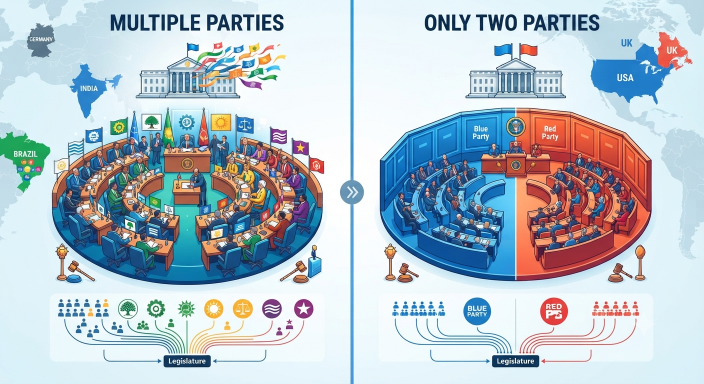
Political parties play an important role in democratic systems. They represent different public interests, introduce policies, select candidates, and compete for the opportunity to govern. However, not every country follows the same political structure. Some nations have two dominant political parties, while others have several parties competing in national elections.
This difference is influenced by electoral systems, historical developments, political traditions, and the diversity of public opinion. Understanding why countries follow different party structures provides a clearer picture of how democracies function around the world.
1. The Influence of Electoral Systems
One of the biggest reasons countries have different numbers of political parties is their electoral system.
Countries using a first-past-the-post system generally elect the candidate who receives the highest number of votes in a constituency. In this system, smaller parties may struggle to win seats even when they receive a reasonable share of the overall vote.
This encourages voters to support larger parties that have a realistic chance of winning.
The United States is a well-known example, where the Democratic and Republican parties dominate national politics.
In contrast, countries using proportional representation allow political parties to win seats according to their share of the vote. This gives smaller parties a better opportunity to enter parliament.
As a result, proportional representation often encourages multiparty competition.
2. Historical and Political Traditions
A country’s political history also influences its party structure.
Some nations developed political systems around two major ideological groups that gradually became dominant. Over time, these parties established strong organisations, voter loyalty, and nationwide campaign networks.
Other countries experienced political movements involving different regional, social, economic, and ideological groups. These movements sometimes developed into separate political parties.
For example, India’s political landscape includes national and regional parties that represent different communities, development priorities, and political viewpoints.
Historical events such as independence movements, constitutional changes, revolutions, and political reforms can also influence how parties emerge and compete.
3. Social and Cultural Diversity
Countries with diverse populations may have a wider variety of political parties because different communities have different priorities.
These differences can involve language, regional identity, economic interests, cultural traditions, and development needs.
In a large and diverse country, a single political party may not represent every concern equally. Smaller or regional parties can emerge to address specific issues.
For example, some Indian political parties focus strongly on regional development, local employment, agricultural concerns, or state-level identity.
This allows voters to support organisations that understand their particular concerns.
However, social diversity does not automatically produce a multiparty system. Electoral rules and political institutions also play a major role.
4. How Coalition Governments Encourage Multiple Parties
In multiparty democracies, it is common for no single political party to win enough seats to form a government independently.
In such situations, two or more parties may form a coalition government.
Coalition governments require political organisations to negotiate, share responsibilities, and agree on common policy priorities.
Countries such as Germany have experience with coalition-based governments, where parties work together to secure parliamentary support.
This system gives smaller parties an opportunity to influence national decisions even when they do not have the largest number of seats.
However, coalition negotiations can sometimes take time, and disagreements between partners may create political instability.
5. Why Two-Party Systems Remain Popular in Some Countries
Two-party systems can offer certain advantages. When two major parties dominate elections, voters may find it easier to understand the main political choices.
Government formation can also be more straightforward because one party usually secures enough legislative support to govern.
The opposition party provides an alternative government and can question policies, decisions, and public spending.
However, two-party systems may limit the range of political choices available to voters. Smaller parties can find it difficult to compete, even when they represent important public concerns.
In some countries, two major parties also contain different internal groups and ideological viewpoints, meaning political diversity exists within the parties themselves.
6. The Role of Smaller and Regional Political Parties
Smaller political parties can have a significant impact on national politics.
They often bring attention to issues that larger organisations may overlook. These can include environmental protection, minority representation, agricultural policies, local infrastructure, and regional economic development.
In multiparty systems, smaller parties can also influence legislation by supporting or opposing government proposals.
Their presence can encourage larger parties to expand their policies and respond to a wider range of public expectations.
However, a large number of competing parties can sometimes make political negotiations more complicated.
7. Which Political System Is Better?
There is no universal answer to whether a two-party or multiparty system is better.
A two-party system can provide clearer electoral choices and relatively straightforward government formation. A multiparty system can provide broader representation and allow more political viewpoints to participate.
The effectiveness of either system depends on democratic institutions, election transparency, political accountability, and the ability of governments to respond to public needs.
The quality of leadership and the strength of democratic safeguards are often more important than the number of political parties.