





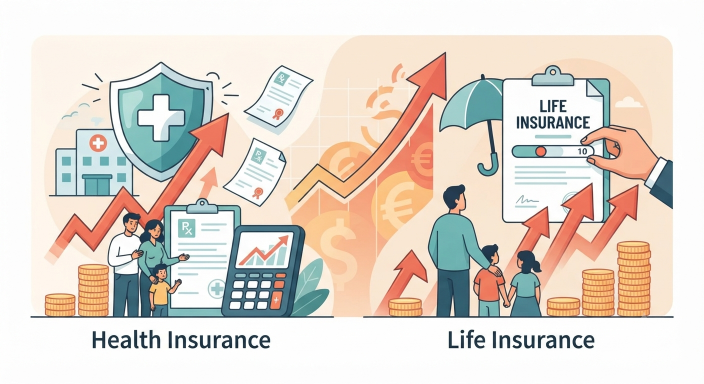
Inflation affects almost every part of everyday life, from grocery bills and transportation expenses to healthcare costs and housing. However, one area that people may overlook when thinking about rising prices is insurance coverage.
The amount of health or life insurance selected several years ago may not provide the same level of financial protection today. As medical expenses and living costs increase, the purchasing power of a fixed insurance benefit can gradually decrease.
Understanding how inflation affects insurance coverage is important for individuals and families who want to maintain financial security. Reviewing existing policies and adjusting coverage when necessary can help ensure that insurance remains useful when unexpected situations arise.
1. Understanding the Relationship Between Inflation and Insurance
Inflation refers to the general increase in the prices of goods and services over time. As prices rise, the purchasing power of money decreases.
For example, an amount that could comfortably cover a particular expense ten years ago may not be sufficient today.
Insurance policies are often purchased with a fixed sum insured or sum assured. While the amount written in the policy may remain unchanged, the actual expenses that the money needs to cover can increase.
This creates a gap between the financial protection provided by insurance and the real cost of future needs.
2. How Inflation Affects Health Insurance Coverage
Healthcare costs can increase because of rising medical equipment prices, hospital operating expenses, staff salaries, medicines, and advanced treatment technologies.
As a result, a health insurance policy purchased years ago may no longer provide sufficient protection.
Consider someone who purchased a health insurance policy with a sum insured of ₹5 lakh several years ago.
If hospitalisation and treatment costs increase significantly, the same amount may not cover a major medical procedure, extended hospital stay, or multiple treatments.
The policyholder may have to pay the remaining expenses from personal savings.
This is why reviewing health insurance coverage periodically is important.
3. Rising Medical Expenses Can Increase Out-of-Pocket Costs
Inflation can affect more than the total hospital bill.
The cost of diagnostic tests, prescription medicines, specialist consultations, surgical procedures, and post-hospitalisation care may also increase.
Even when an insurance policy covers hospitalisation, certain expenses may fall outside its coverage.
For example, policyholders may face costs related to exclusions, non-medical items, deductibles, or co-payment requirements.
If the sum insured is too low, the financial burden can become even greater.
People should therefore review both the coverage amount and the policy’s specific terms.
4. How Inflation Impacts Life Insurance Coverage
Life insurance provides financial protection to dependants if the insured person passes away during the policy term, subject to policy conditions.
However, the financial needs of a family generally change over time.
Expenses such as children’s education, housing loans, household costs, and healthcare may become more expensive because of inflation.
Suppose someone purchases life insurance with a sum assured of ₹50 lakh. Several years later, the family’s financial responsibilities may have increased considerably.
The same amount may no longer provide sufficient support for dependants.
This is why life insurance coverage should be reviewed as income, responsibilities, and financial goals change.
5. Inflation Can Reduce the Real Value of a Life Insurance Payout
The nominal value of an insurance payout refers to the actual amount received, while its real value refers to what that amount can purchase.
For example, ₹50 lakh received today may have considerably more purchasing power than ₹50 lakh received 15 or 20 years later.
If inflation continues over an extended period, the future value of a fixed life insurance payout may be lower in terms of purchasing power.
This is particularly important for families depending on life insurance proceeds to fund long-term financial needs.
Selecting appropriate coverage requires considering future responsibilities rather than focusing only on current expenses.
6. Increasing Your Insurance Coverage to Manage Inflation
One way to address the effects of inflation is to review and increase insurance coverage when necessary.
For health insurance, policyholders may consider:
- Increasing the existing sum insured.
- Purchasing a suitable super top-up policy.
- Reviewing hospital network access.
- Checking room rent restrictions and co-payment clauses.
- Comparing policy benefits and exclusions.
For life insurance, individuals should estimate how much financial support their family would need if their income were no longer available.
Considerations may include outstanding loans, future education expenses, household spending, and existing financial assets.
Some insurance products also offer increasing-cover options, where the sum assured rises according to specified policy conditions.
7. Does Increasing Coverage Always Mean Higher Premiums?
In many cases, choosing a higher sum insured increases the premium. However, the exact cost depends on factors such as age, health status, policy type, coverage options, and insurer pricing.
For health insurance, purchasing additional coverage at a younger age may sometimes be more affordable than waiting until later.
Life insurance premiums also depend on factors such as the insured person’s age, policy term, sum assured, and underwriting assessment.
Rather than choosing the cheapest policy, compare the overall protection, exclusions, benefits, and long-term affordability.
8. The Importance of Reviewing Policies Regularly
Insurance needs are not fixed throughout life.
A person who is single may have different financial protection requirements compared with someone who has children, a home loan, or dependent parents.
Similarly, healthcare requirements may change as people grow older.
Reviewing insurance coverage annually or whenever there is a major life change can help identify gaps.
It is also useful to check whether the insurer offers restoration benefits, no-claim bonuses, inflation-linked coverage, or other features.
These benefits should be evaluated according to their specific terms rather than assumed to provide automatic protection against rising costs.
9. Practical Tips for Protecting Yourself Against Inflation
Maintaining adequate insurance coverage requires a combination of financial planning and regular policy reviews.
Start by calculating your current financial responsibilities and estimating how they may change in the future.
Compare your existing coverage with current healthcare costs and family requirements.
Avoid depending entirely on employer-provided health insurance because employment-related coverage may change when you switch jobs or retire.
For life insurance, choose coverage based on your family’s financial needs rather than selecting an amount simply because it is affordable.